
A new report from President Obama’s jobs council  reflects a major dispute between corporate and labor leaders over tax reform. According to Reuters, the report “notes disagreement among council members over whether to shift to a ‘territorial’ system that exempts most or all foreign income from corporate taxes when it is repatriated.”
The report is from the President’s Council on Jobs and Competitiveness, which includes labor and business leaders and is chaired by Jeffrey Immelt, CEO of the notorious tax dodger, General Electric.
A “territorial” tax system is a euphemism for exempting the offshore profits of U.S. corporations from our corporate income tax. The bottom line is that our current system already provides a tax break that encourages U.S. corporations to shift investments offshore, and a “territorial” system would expand that tax break.
The existing tax break is the rule that allows U.S. corporations to “defer” U.S. taxes on their offshore profits until those profits are brought to the U.S. (until they are “repatriated”). Often these profits remain offshore for years and the U.S. corporation may have no plans to repatriate them ever.
This “deferral” of U.S. taxes on offshore profits provides an incentive for U.S. corporations to shift operations and jobs to a lower tax country, or just use accounting gimmicks to make their U.S. profits appear to be “foreign” profits generated in offshore tax havens.
These incentives for corporations to shift jobs and profits offshore would only increase if their offshore profits were entirely exempt from U.S. taxes, as would be the case under a territorial tax system.
Labor leaders know this, and labor unions have joined other organizations in opposing a territorial system. In October, when there were rumors that the Congressional “Super Committee” might propose a corporate tax reform, the big unions joined a letter to the committee members urging them to reject any proposal for a territorial tax system.
Corporate leaders, on the other hand, have been calling for a territorial system because of the benefits it would provide for corporations trying to lower their tax bills. The likely “disagreement” cited in the White House report probably was between the labor leaders and corporate leaders on the President’s jobs council.
As we explain in this fact sheet, the real answer is not to adopt a territorial tax system but to end “deferral.” Here’s a report making the same case in much more detail.
Ending Tax Breaks for Companies Moving Jobs Offshore
 President Obama hosted an “Insourcing American Jobs Forum” last week with business leaders who are bringing jobs back to the United States. During the event, the President announced he’d soon “put forward new tax proposals that reward companies that choose to bring jobs home and invest in America. And we’re going to eliminate tax breaks for companies that are moving jobs overseas.”
As already explained, the most straightforward way to do this would be to end deferral.
Another possibility is that the President could push some of the modest, but still helpful, proposals made early in his administration to limit the worst abuses of deferral. (Here’s a CTJ report explaining these proposals.) Unfortunately, the President immediately started backing away from these and dropped the most significant of these reforms (a change to the arcane-sounding “check-the-box” rules) by the time he made his second budget proposal.
Real tax reform depends on the administration being far more willing to stand up to the corporate CEOs — including those who sit on his jobs council.
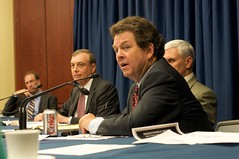
Photo of Council on Jobs and Competitiveness via The White House Creative Commons Attribution License 2.0

 during last Saturday’s
  Massachusetts. The ad uses Romney’s support of user fees to question his anti-tax credentials because it says that user fees are essentially a “tax by another name.”
 candidates’ tax plans, includes a “territorial” system that would exempt the offshore profits of U.S. corporations from U.S. taxes. This is essentially a way to expand and consolidate the existing loopholes that encourage U.S. companies to shift their investments offshore.
 orm (heavily stacked with business interests), and low-income families would face the largest tax increases relative to their income. Upper-income families, by contrast, would enjoy a bonanza, with the richest one percent taking home over $2,800 in tax breaks per year.
 policy proposals that are gaining momentum in states across the country. This week, we’re taking a closer look at proposals which would lessen a state’s reliance on progressive income taxes, often by shifting to a heavier reliance on regressive sales taxes.
  Governor’s office, Steve Beshear is
  free-market Oklahoma Council of Public Affairs is
 Caucus the once unstoppable ethanol tax credit
  Congress made a huge compromise before they even began negotiating with Republicans. Economists agree that the government measures most likely to boost job creation are spending measures (including things like food stamps, infrastructure, hiring teachers) but President Obama decided to focus on a tax cut in order to appeal to Republicans.
 Then something strange happened. Republicans in House refused to approve the Senate bill. They voted along party lines to appoint a conference committee iron out differences between the Senate-passed bill and a bill passed earlier by the House. But the Senate had already left town.

 economics
